
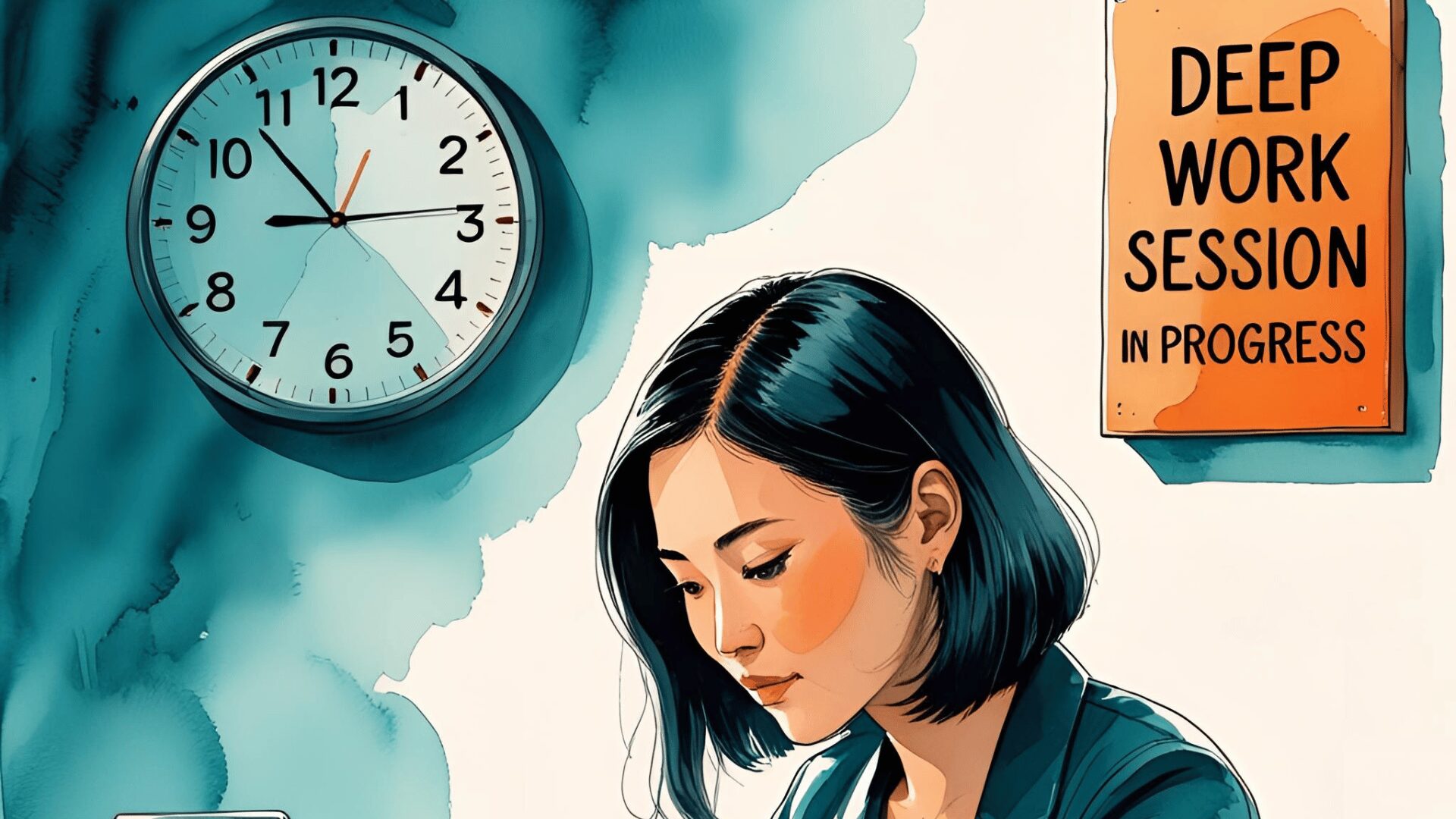
Building your business as a side hustle until you're ready to leave your 9-5? It's not easy - but the practice of 'deep work' might help you get there more quickly.
'Deep work' is a simple concept - an approach that can boost your productivity with just a few simple changes to your working environment.
Note: as someone with ADHD, I've found this to be a game-changer, so fellow neurodivergents, this might also be helpful for you:)
'Deep Work'
'Deep Work' - coined by Georgetown University Computer Science Professor Cal Newport - is about working on high-value tasks for concentrated bursts of time in a completely distraction-free environment. It requires a little commitment to planning and some practice, but the payout in productivity is well worth the effort.
On any given workday, our productivity is hampered by interruptions such as calls, queries, or simply moments when our focus drifts to other things. In fact, it's suggested that many of us can complete a day’s work in just four hours if we create the right working environment.
Shallow Work v High Value Thinking
The majority of our everyday tasks are what Cal terms 'shallow work'. Things like daily meetings, status updates, email responses and other regular tasks, while necessary, are unlikely to use all of our brain power and are often done while multitasking.
These tasks can get in the way of work which requires a lot of cognitive effort, or 'high value thinking' - such as research, book-keeping, report-writing or planning.
This is because our brains are not designed to multitask; the constant stream of notifications, emails, and social media pings easily fragments them.
By engineering your environment to support deep work, rather than relying solely on willpower, you can increase your output dramatically - and that's good news for side-hustlers!
Here's how ...
Create a Distraction-free Zone
Set up a dedicated workspace, turning off all notifications on your phone and computer, and closing any non-essential tabs. Let others know you mustn't be disturbed for the next 60 or 90 minutes.
By physically and digitally removing the temptation to switch tasks and the likelihood of people coming in and asking you questions, you lower the cognitive load on your brain. This frees up your mental energy, allowing you to achieve a state of intense focus and produce higher-quality work in less time.
Embrace the Boredom!
One of the most difficult things about living in a world full of constant distractions is that we've become afraid of being bored. Adverts on? Check your phone. On a train? Listen to music or clear out your pockets - anything rather than sit in the stillness of our own minds!
Yet this is precisely what makes our minds wander when we're working on difficult or repetitive tasks.
So, train your mind to be 'ok' with not being entertained.
Sit with yourself, doing nothing. I'm not talking about meditating here (although that is a super-effective way to learn to focus!). I'm simply talking about learning to resist the urge to break from the boredom. You might last a minute or two, or maybe longer, but the more you practice this, the easier it will become to stay on task with mentally challenging activities.
Using Rest as a Contrast
If you feel that you are 'switched on' all the time (though not necessarily being productive), it's also important to train your brain on the difference between being 'on' and being at rest. Creating clear boundaries and rituals for both can help to achieve this:
Create a 'Clocking Off' Routine
For example, you should have a definitive "shutdown" at the end of your workday. Review the day's tasks, make a quick plan for the next day, and then consciously declare your workday over. This simple act tells your brain that it can finally disengage, allowing for genuine rest.
Without this clear signal, your mind can stay in a state of perpetual low-level anxiety, continuing to throw out work-related thoughts. By respecting your rest, you not only recharge but also train your brain to engage more intensely and focus more deeply when it's time to get back to work.
Planning Your Start-up with a 'Deep Work' approach
Below is a suggestion to help you plan around your main hustle - assuming that your day job is a 9-5. However, if this approach intrigues you, I expect you'll make your own to fit around your working day.
Ahead of your deep work session (I do this the night before), identify which of your tasks qualify as high-value thinking and prioritise them. This means you can go into your 'deep work' session, organised and ready to work.
Mornings: 1 hour - 'Deep Work': Mornings are your 7 AM meeting with yourself. Try waking an hour earlier, grab your preferred hot drink, and move to your distraction-free zone to complete an hour of deep work before your usual day begins. When I was working full-time and setting up Blue Moose, I found that this gave me a great start to the day ahead.
Lunchtime: 30 mins - 'checking-in': Lunchtime is rest-time, but you can still tidy up small tasks. Things like replying to emails or scheduling social media posts, or jotting down ideas, are
Evenings: 90 mins - 'Deep Work': Your main hustle is done, and this is your prime time to build your own. After a short break to decompress, dedicate a full 90 minutes to a single, high-value task. When your 90 minutes are up, stop; zombies make terrible business owners ...
Weekends: 'Freestyle': Perhaps you'll choose to do a few 'deep work' sessions over your weekend, but remember to take time to recharge. If you're opting for work with a lighter touch, look at what online courses may be helpful, browse your competitors, or source useful platforms and groups. These are all important elements of your work that can be done in short stints, without draining your brain power - or your precious weekend time.
Growing your business while working a full-time job is tough - but sometimes, a few of the right tools can help make the journey a little smoother, and maybe a little faster, too:)
If you try this approach, I'd love to know if it has been as helpful for you as it has for me!

