
I spent decades believing that the 'dream job' was an urban myth ...right up until I started working for myself. It took a little soul-searching, and some heavy-handed 'tough love' from the universe - the kind where it rips the rug out from under your feet 'for your own good' - but it worked. Eventually.
Being your own boss can allow you to custom-build a job around your passions and abilities, making space for that elusive glow of fulfilment that (more or less) makes you throw off the covers and start the day. But it doesn't start with choosing a path and making a go of it. I think it begins much earlier than that.
Shedding your societal skin
As kids, when someone asks what we want to be when we grow up, we lean into what we love: our favourite animals (llama-keeper), foods (cake shop owner), or special interests (Lego-builder; Formula 1 driver, fairy princess).
Then we grow up, learn to be 'sensible', and focus relentlessly on what we can do, or what's available, rather than who we are. We casually overlook critical factors like our personality traits, core values, and psychological boundaries in lieu of marketable skills, predictable salaries, and pension perks.
After years of always feeling I was in the wrong job, I realised it was time to create the right one from what brought me joy. This meant reconnecting with that little ginger inner-child who still thought nothing was impossible ...chaperoned by a responsible adult, of course; there's little demand for fairy princesses these days.
A little background...
As a single parent, job satisfaction always seemed a luxury against the reality of paying bills. But even now, in my fifties and with two grown-up daughters, I still thought of it as a frivolous 'nice-to-have'.
Having grown up in a housing estate, and at a time where teenage pregnancy was how to get a flat, my burning flame of creative ambition was quickly doused by the reality of life. I shared my dream of going to art school only once - and never did it again. So I worked my way through a litany of jobs: carer; admin assistant; autism practitioner; nanny ...each of them hanging on me like a dress knitted by a well-meaning, but myopic, granny.
Eventually, hoping to set a precedent for two small children, I got a psychology degree and built a career of sorts. Many years later, I retreated to a small island in Scotland, leaving behind a stressful CEO position and a bog-standard mental health crisis.
Time for a stock-take, I thought.
And then, from a chance reading of a book about a 1000-year old Japanese philosophy, I had an epiphany.
Ikigai
Ikigai, I read, was about 'finding your bliss' through living a life of value and purpose. In a (slightly westernised) nutshell it comes down to four simple things:
- Doing something you find joy in ...
- ...that you are good at
- ...which is of value to the world
- ...and that people will pay for
Sitting there, book in hand, a light went on. I wasn't just looking for a better way to work; I was looking for a better way to live.
If we want to feel joy in our work, we need to work with our passions; to feel competent, we must work to our strengths; to feel valued, we need to be of value ... all packaged in way that you can make a living.
Admittedly, it's not rocket science, but then, the simplest ideas often fly under our radar as we seem to have a thing for complexity.
I decided to use this philosophy, alongside some psychology and business tools, to work out my next steps - and find a business idea that truly resonated with who I was and what I loved doing.
It turned out to be a pretty fascinating expedition into the cobwebbed corners of my mind. Here it is - both the journey and the cobwebs; I hope it might help someone else to rediscover their passions and create their own 'dream job' ...
1. Identify your passions and skills
Your Passions
What things do you always return to, to relax, or have fun? The things you do that make time disappear? In positive psychology, this is called 'psychological flow'. These are activities that completely swallow you up, absorbing you to the point where you forget to eat/sleep/that you have children. By starting with your passions—even if you use them as indirect springboards—you're far more likely to keep up the momentum long after the novelty of self-employment has worn off.
Make a list of things that genuinely bring you joy: your passions, hobbies, and quiet obsessions.
Your Skills
Your skills are obviously the ideal starting point for your business, but they may also be transferable to other startup ideas that you come up with. Having them ready in your arsenal will help you find potential workarounds for challenging areas later in the process.
These skills and passions don't have to be work-related. That can come later.
Write down things that you're good at - skills and competencies gained through life or work experience, or through study.
Here were my top four skills and passions ...
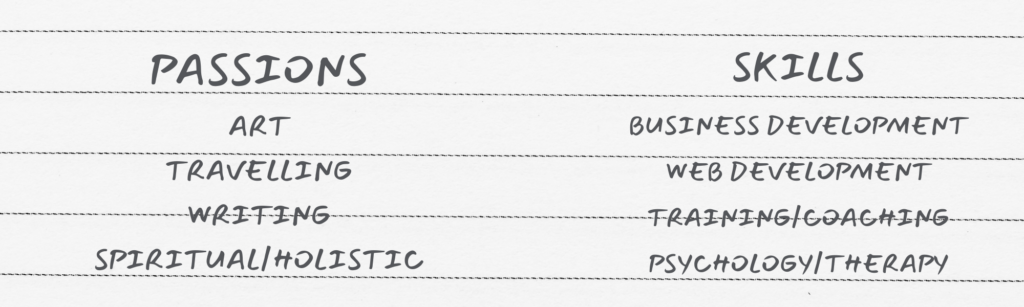
Now we will use these to do some full-on brainstorming ...
2. Generate your business ideas
The heuristic ideation technique (HIT for short) is a simple idea developed by Edward Tauber, father of Brand Extension Research. It's incredibly effective for coming up with new ideas quickly as part of any good brainstorming session.
Draw up a grid, inserting your passions down one column and skills across the top row.
It's best to keep the grid small - around 4 columns/rows at a time. Then, combine each to generate startup ideas that involve both a passion and a skill. Importantly, another part of Ikigai is the concept of going with the flow, so it's important not to pre-judge or restrict ideas for the moment.
Here's my original grid ...
| BUSINESS DEVELOPMENT | WEB DEVELOPMENT | TRAINING/ COACHING | PSYCHOLOGY /THERAPY | |
| ART | CREATIVE AGENT | WEBSITE DEVELOPER FOR ARTISTS | FUN ART CLASSES FOR ADULTS | ART THERAPIST |
| TRAVELLING | FREELANCE TOURISM BUSINESS DEV CONSULTANT | TRAVEL WRITER (BLOGGER) | MOBILE ART CLASSES | MOBILE/ONLINE COUNSELLOR |
| WRITING | BUSINESS DEVELOPMENT BLOGGER | COPYWRITER/ WEB CONTENT CREATION | FREELANCE COURSE DEVELOPER | SELF-HELP WRITER |
BUSINESS | BUSINESS START-UP CONSULTANT | WEBSITE DEVELOPER FOR STARTUPS | BUSINESS STARTUP TRAINING COACH | BUSINESS MENTOR |
3. Filter through and shortlist top ideas
The beauty of the first brainstorming step is that, by leaving your judgment at the door, you can come up with some pretty creative ideas you might not otherwise think of. Try this process as often as you like, then shortlist those that resonate with you. However, don't analyse them too much at this point - some left-field ideas could have great business potential if they are tweaked a little!
Shortlist those ideas which you feel have potential or which resonate with you.
My Shortlist
Having gone through the HIT process a few times, with various other interests, I came up with around 30 business ideas - some of them, solid, others, real doozers:) After eliminating ‘Mystic Web developer’ (holistic/web design) and ‘Plant therapist’(nature/counselling), amongst others, I settled on the following:
Creative Agent for new artists
Mobile art classes for adults (BYOB)
Art therapist
Travel writer/blogger
Web content creation
Once you have your list of potential business ideas let's look at which of your business ideas fit with who you are as a person.
4. Revisit your personal values
Personal values are so often undermined, and many of us live for decades with values we have acquired as children and never revisit. This can mean that we are looking in the wrong places for fulfilment and can't understand why we don't find it. What we often don't realise is that personal values are not static; they change as we go through life and experience new things.
I connected with my personal values for the first time during this process and realised why I had felt so 'trapped' by the jobs and life situations I'd been choosing. Far from learned beliefs around 'respectability', 'obedience, and 'conforming' I valued almost the opposite - creativity and freedom with a slice of anarchy. For me, all of my chosen ideas fit perfectly; they all required an element of creative thought, could all be built around my itchy feet, and had the potential to disrupt the status quo.
Even if you have already settled on your business idea, I'd say spending time looking into your values is essential. They can help or hinder your business dramatically, so understanding how they impact you may change how you develop your ideas.
Take some time and write down what you feel matters most in life.
You can learn more about how to find your personal values if you're not sure where to start. Then, compare your business ideas, and find which fits them best.

5. Doing good
A key part of the Ikigai philosophy lies in doing something of value to the world. Now, a little chronological and cultural relativism is needed here, as chopping logs or making pots or scented oils is more niche than it once was. However, the same basic principles of doing something the world needs still stand. And the ripple effects of 'good business' travel far - whether it's a social enterprise or a sole trader with strong ethics.
Which of your business ideas makes life easier or better for others in some way? Perhaps offering them security, entertainment, well-being or more free time? Together with your personal values, knowing your value to the world can be the thing that gets you through difficult times and builds your resilience to keep going - and, as importantly, enables you to come from a genuine and authentic place in your business.
List briefly what needs your business idea can fulfil, problems it can solve, or how it makes life easier for others.
This is not your business offer (eg., counselling) but rather what your offer means to them (eg., well-being, or healing).
Dealing with your Startup Demons
Let's start off with some pretty telling statistics:
- Well over half (63%) of the UK workforce dream of starting their own business,
- 43% of these aspiring entrepreneurs never do it.
- 1 in 3 people hate their jobs.
Disclaimer: The data uses the term 'dislike'. However, I'm fairly confident that if you're already 'disliking' your job, it's a matter of time before you descend into the seventh tier of job hell.
So why are around 9.3 million people potentially walking around with a business idea that might never see the light of day?
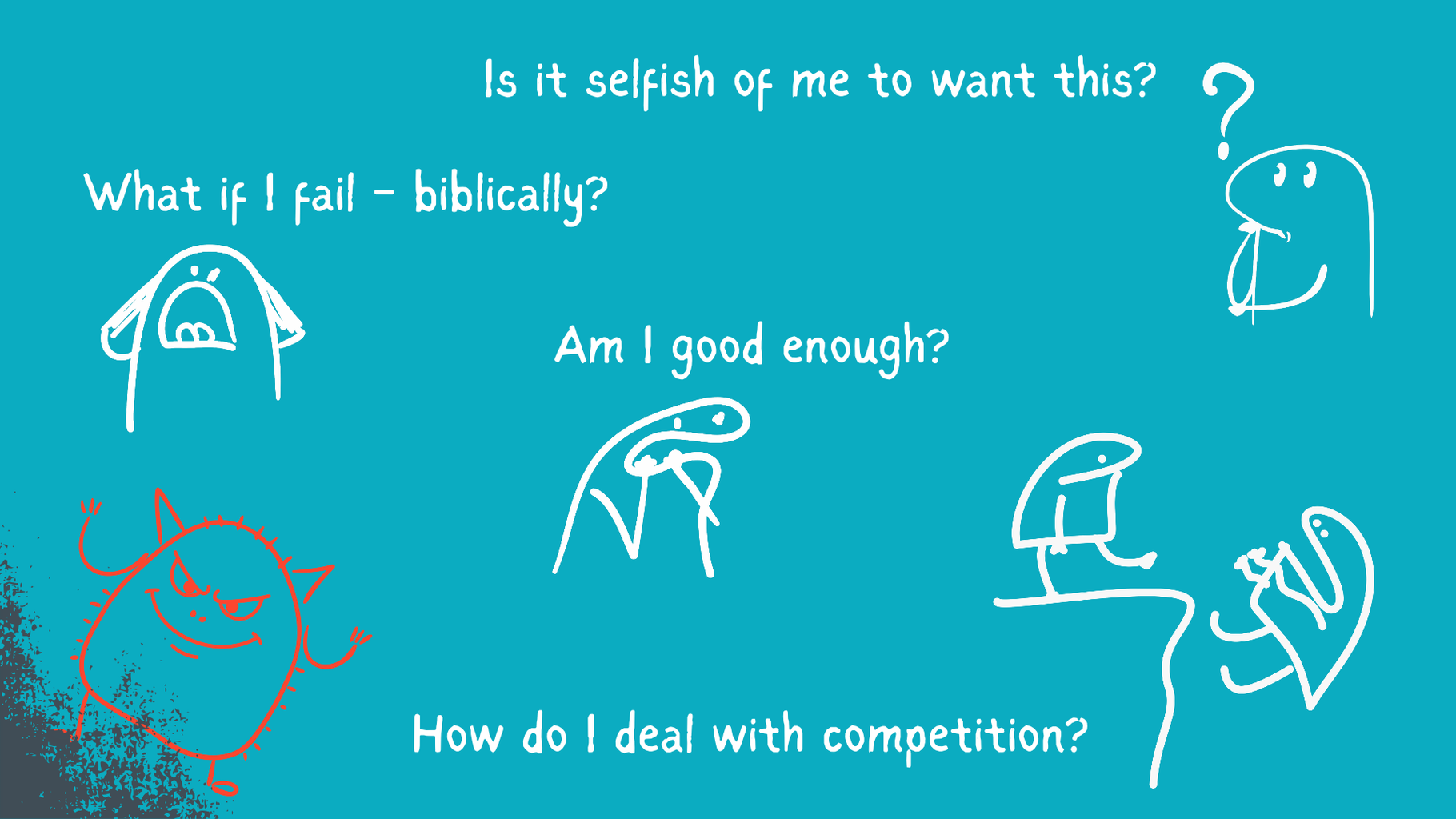
Fear of failure, stress, competition or lack of finance are, as you might expect, among the most common reasons.
In fact, men typically worry more about competition and failure, whereas women worry about not feeling qualified enough or having the relevant skills
A business idea might look solid on paper, but if your brain has already thrown itself under a blanket, it's going to be an uphill struggle.
elow are some of the most common fears around starting a business - and how we can learn to work through them ...
Fear of change
Unless you're an addrenalin junkie, thundering into the unknown can be daunting. Inviting change might just mean we lose what we have right now with no guarantee of something better on the other side. This can stop a dream of self-employment dead in its tracks.
Managing your Transition to Self-employment
But the transition to self-employment needn't be a jumping-off-a-cliff-scenario, hoping you learn to fly before you hit the ground. Leaving the wrong job in the right way can enable you to move at your own pace, account for slow growth and still have an income in the meantime.
By setting up your business as a side-hustle and managing your time effectively, you can try your business on for size with minimum risk. Consider, too: can you negotiate a shorter working week? Or perhaps you can work on your business in the evenings? If you are providing a remote service, you will have a lot of flexibility to work around your commitments, but even an in-person service can be managed with a good booking system!
By visualising how your full-time business day would look, and working backwards to meet your current constraints, you can create (or get help to create) a Route Map to help you to manage your transition more easily.
A side note: if you have a family, it's understandable if you feel you might be risking their security and wellbeing as well as your own. However, a slow side hustle, if you can do it, is a way to delay making the jump until you feel ready. And in the end, you'll have more time to spend with them - just as the little cherubs hit teenagedom and decide they hate you and the horse you rode in on …
Overcoming Low Confidence
Finding confidence in a vacuum is perhaps the toughest challenge of all - speaking from personal experience. I had a pet 'Jeminiah Cricket' on my shoulder who would tell me I didn't have the chutzpah, skills or staying power to start my own business. In fact, she would drill in how conceited I was for not just putting up and shutting up like everyone else And it's hard to win a fight with an imaginary insect.
The 'Fake-it-til-you-make-it' trap
This is only my opinion, and I know many swear by this approach, but I have my concerns around it, despite having used it for years.
From a psychological standpoint, the further you move away from your authentic self, the longer the shadow you cast. For me, this contributed to my relentless cycle of working twice as hard in a job to assuage my imposter syndrome, whilst looking like I'd just won a holiday to the Bahamas on the outside. The outcome? Stressed to the bone, I would eventually hand in my notice with everyone scratching their heads as to why.
I think if you can, be authentic. And if you feel vulnerable, be authenticically vulnerable. People root for the I'm still on that journey, but I've picked up some good CBT tools like 'examining the evidence' (do I have proof that , noticing black and white thinking, (it's all bad or it's all good)
However, I have referred regularly to this simple but insightful worksheet on Assertiveness
Learned Helplessness
Sometimes, we just get stuck in a rut. Learned helplessness, coined by American Psychologist, Martin Seligman, is a behavioural theory that proposes we can learn to believe that we have no control over our future if we stay in a toxic environment for long enough. In a wider sense, we can feel powerless to escape from jobs, relationships and other long-term situations, often rationalising our paralysis with comments like ‘that’s life’, or ‘I deserve it’.
We all know that how we see ourselves and what we believe about ourselves plays a huge part in the choices you make in life; those of us with a healthy level of self-esteem are more likely to be proactive in unhealthy situations.
Believing that you have the agency - and the right - to change your circumstances is one of our most powerful life tools.
Learned helplessness can also be unlearned, and practising assertiveness or challenging negative thoughts can help build your self-esteem and confidence. It may take a burst of courage at the beginning, but, interestingly, you might find that starting your own business can actually be its own solution.
Self-confidence is essential to having the resilience to get through challenging times in business. But, thankfully, if there's not much there in your arsenal, you can do a lot to improve it. (See my blog on 'Confidence in Business'.)
In her TED Talk, Brittany Packnett Cunningham describes confidence as "...the necessary spark before everything that follows; the difference between being inspired and actually getting started'.
Guilt
Sometimes there is a sense of guilt about wanting something that changes the status quo. Perhaps you and your partner work hard to stay afloat, and it seems selfish to want more - or frivolous to dream of better. You might also be battling with old values, instilled by early influences, (eg., 'You’re lucky to have a job'; 'Keep your head down', etc) It's hard - but necessary to challenge long-standing beliefs and values about yourself and the world.
If you’re feeling guilty about the prospect of leaving the security of a salary, try to pinpoint the key issues which drive this emotion and talk through them with your significant other. You may even find your sense of guilt is misplaced; communication is everything.
'Wanting better' need not bring on a guilt-trip, but can instead be seen as an opportunity for adventure, if looked at through the right lens. And if the fear of failing others is what's stopping you, work out how you could recover from a worst-case-scenario to lessen that fear. Recovery is always possible - even if that's returning to paid employment. By giving the same energy to considering the potential benefits as you do, the risks, you are giving your business idea a fair shot.
Worries about Age
Sometimes, age can feel like an issue. Depending on how many times you've blown out those birthday candles, you may wonder if you have lived enough - or too much - to make the jump into self-employment. But age shouldn't matter, and in fact, there are many advantages on both ends of the continuum ...
The ‘younger’ start-up (eg., Gen Z, Y)
- You might have more energy and be less risk-averse - the joys of youth!
- You are more likely to be adept with platforms and apps that could make your job much easier
- Support and connections may be easier to come by; people - particularly grant funders - love a fresh, young startup
- You might not yet have many lifestyle commitments, such as family, or a mortgage
- Millennials/Gen Zs are more likely to have a degree (39%) to add to their credentials
The ‘mature’ startup (eg., Gen X and earlier)
- You probably have a good idea of who you are - at least, more than you did in your youth!
- It's more likely you'll have built up friends or contacts over the years who can lend a hand or connect you
- You are more likely to be risk aware and be able to spot potential issues
- You may be less inclined to sweat the small stuff and see things through
- Your dependants might have flown the nest, with more time and freedom to start a new business
- For the 59% of Baby Boomers not in employment, self-employment (particularly consultancy) can be a viable way of pulling together decades of real-life experience that will be valuable to others
Losing Momentum or Status
Walking away from a reputation you may have built up over years in a company can be tough. However, that reputation will pay dividends in other ways, through connections and opportunities, once people know you're 'going it alone'. Often the concern is more about losing status, should you need to return to a similar role at a later point. But running your own business more often elicits admiration, rather than consternation - especially if you're moving in similar circles.
However, self-employment brings its own status and gives valuable experience, which, if you decide later it’s not for you, will make you stand out as a driven self-starter to any future employer. Also, the appeal of status can often tend to lose its shimmer when you find contentment where it really matters. I say this as someone who worked themselves into the ground to prove my own worth, then found it had nothing to do with where I was on the societal ladder.
If you feel that your business idea has potential, don't let fear or guilt be the reason you don't try. Pick a demon; name it; own it and work with it. Then move on to the next one. Only by facing our fears can we really hope to move forward - in life as well as in business. I've always liked German-American poet, Henry Charles Bukowski's take on this process:
"Don't fight your demons. Your demons are here to teach you lessons. Sit down with them, and have a drink and a chat, and learn their names, and talk about the burns on their fingers and scratches on their ankles. Some of them are very nice."
6. Call out your dealbreakers
If we identify and address our known fears before we start, we can meet them head on before they become a problem.
A healthy relationship with your business is vital for sticking with it when the waters get choppy. But much like any relationship, self-employment comes with its equivalent of wet towels on the bed: annoying quirks, tedious chores, and to-do lists that never seem to shrink.
Knowing the difference between a true dealbreaker and a minor stumbling block makes the difference between pulling through and pulling the plug.
Too often, we ignore the warning signs of chronic over-extension under the rose-tinted banner of 'building character'. The reality check? Not every professional challenge is an exciting opportunity for personal growth. Sometimes, a brick wall is just a brick wall. If a core part of your dream business involves managing staff—something that fills you with dread—trying to force it day in, day out is a fast track to burnout that risks sinking the whole enterprise.
Dealbreaker versus Stumbling Block
Every business involves tasks you can technically do but would rather avoid. These aren't dealbreakers. If a dull or difficult task isn't all you do all day, chances are you can handle it in small, manageable doses.
- Stumbling Blocks: A hurdle that you can work around, outsource, or redesign.
- Dealbreakers: A non-negotiable core requirement of the job that you categorically cannot provide, have no workarounds for, and which will turn your soul into a black abyss.
Working for yourself gives you the freedom to navigate stumbling blocks in ways a traditional job never would. But if a job spec lies so far outside your wiring that it makes you want to pack it all in, let's look at it head-on before you launch.
Write down any tasks tied to your business idea that make your stomach turn, and rate them using these categories:
Hurdles to clear — Minor barriers or skill gaps that, with a little time, scaffolding, and practice, will be fine.
Hard pass — Absolute boundaries; things you categorically won't or can't do (your true dealbreakers).
Heavy going — Tasks you have the skills for, but simply loathe doing in large doses.
My personal dealbreakers ...
Having spent a long time working in roles that were just not me, I listed what I knew didn't fit with my personality or skills, and which would seriously impact my motivation or sanity:
- Public speaking: (Been there, done that, repressed the memory)
- Repetitive roles: (Doesn't work well with neurospicy brain)
- Managing staff: (Just. No.)
Note: 'giving up' rather than 'growing and learning' around certain challenges might seem defeatist! But if there are certain aspects of a business idea that are dealbreakers, acknowledging these can help you shape ideas to work to your strengths from the outset.
- Finding workarounds
Could you outsource these tasks? Can you change the parameters of your business idea to circumnavigate them? Or perhaps partner with someone with these skills, knowledge or traits?
For example, if you're worried about your numeracy skills around invoice/proposal development, take a deep dive into current CRMs; tax, VAT, discounts, and instalment calculations are fully automated and negate the need to take off your socks to count:)
Or perhaps you are a gifted artisan with the organisational skills of a pug? Why not consider partnering up with someone part-time, or hiring a VA to take on some of your admin tasks for you? There are many in the gig economy (eg., Upwork, PeoplePerHour) that provide services at a reasonable rate, and it may just be the difference between gaining and losing clients!
Take each dealbreaker in turn and consider how you might work around it. Try to remove your emotional attachment to each barrier to establish a practical approach, treating each as a problem to be solved rather than a critical judgement of your abilities. Use the HIT technique for this too.
7. Assess your business idea viability
Whilst a business idea may seem a perfect fit for you, it must also be sustainable. Let's look at the final Ikigai element - commercial viability.
Consider the practical elements of your business idea in terms of:
Outlay - what costs will you have to start up? (e.g., training, equipment, etc.) What, if any, financial resources do you have? Are there cheaper ways to get what you need? (eg., second-hand equipment, funding for training,
Overheads - what regular costs will you have to factor in? (e.g., rent, insurance, etc) Depending on your business area, these can mount up. Be thorough and be brutal!
Available market - how much demand is there for your services? Do some online research, check with keywords, engage on social media, ask questions of those in know.
Competition - who else is doing it - and what makes you stand out? (your USP) Look at what rival outfits are doing, how they're selling, who they're selling to ...and how you could be better.
Target audience demographics - who will be using your services? Identify your customers by segmenting your audience, and considering their wants and needs.
Location - are you home-based, do you need an office, or will you be mobile? A business takes time to grow, so keep your costs low in the early days if possible.
You'll also want to consider other practical considerations, such as family and financial commitments, long-term plans, and health.
My viability check
From the list, I now had a few good ideas that sounded feasible. Now, it was time to look at how workable each would be from a business perspective. Whilst your selection will likely be wildly different from mine, my workings below will hopefully provide some insights:
Art Therapist
This could be the ultimate form of my Ikigai, helping others with my passions for art and psychology. However, looking into professional art therapy qualifications, I found that the cost was around £16K for the most basic certification of a 2-year course. In total, an MA would be around £22K and 3 years’ study - not viable.
Online Counsellor
Instantly, this had a lot of mileage for me; I had enjoyed running a psychotherapy training centre and already had a background in psychology and counselling. Moreover, it aligned with the Ikigai concept of world value. However, researching further, there were significant time factors around additional training, and the huge issue of time needed to build reputational momentum sufficient to survive. I removed this option from my list.
Content Creation/Business Coach
These ideas played to my skills and experience, and incorporated my passion for all things business. Further, they could be put in motion immediately. I combined both - creating content for businesses and providing advice as an organic part of my service. I researched the current landscape, what others were doing, and who they were targeting. Despite having worked across both for over 20 years in one guise or another, I had a bit of catching up to do, but that was ok.
Write a basic business plan
Opinions can vary dramatically on the value of a business plan, but it is, hands down, the most effective way to get a clear outline of your aims and objectives, opportunities and barriers, and critically, business concept viability. Using a business plan, you methodically work through every aspect of your setup and leave far less to chance. It doesn't have to be fancy, and you don't have to spend weeks doing it.
Download the free business plan template from Business Gateway to get started. You will likely dip into different areas with concrete ideas, and this will help to inform other elements of the plan. However, as you get deeper into the details, other factors will crop up. For this reason, wait until you've completed the key concepts of the business plan before diving into the financial projections. (The viability check above, should provide a general idea of whether the business is likely to be sustainable, with outlay costs, available savings, etc).
Have you found your Ikigai?
Hopefully, you will now have a workable business idea that encompasses your skills, passions, and values. Of course, finding a sense of fulfilment in work depends upon so many factors that are unique to you. Take a breath; imagine yourself on a normal day in your new business. Does your business idea pass the Ikigai test? Does it involve something you love, that you're good at, that is needed and viable?
If it does, perhaps it's time to make your move 🙂
Slow build or cliff jump?
Nothing in life is failsafe, but looking deeper into these elements can help you to feel more confident that you are heading in the right direction. How you take your first steps, however, depends on various other factors, like what your work day looks like right now, what family commitments you have, or whether you have a financial buffer to see you through the startup period.
If you're looking to start slowly and ease yourself into your self-employment as a side-hustle, read my blog on Deep work: How to Make Time for your Side Hustle.
My next steps ...
At the end of this process, I shelved my books, binned my notes and cleaned out the copious cups on my desk.
That week, I started working freelance alongside my day job on various online job platforms. My client base grew rapidly - with good people I wanted to work with (another perk of working for yourself!). Possibly for the first time, my genuine passion and enthusiasm for my craft burned brightly. And, finally, I took the plunge. Handing in my notice at my daytime job - and suffering a few (ok, many) sleepless nights - I set up Blue Moose, a modest but successful business which gets me out of bed in the morning with a smile - rather than a panic attack.
Of course, there have been some real clangers over the last 10 years, and occasionally, things will dull my sparkle. But it has all been worth it - so far. And I think I could honestly say I've found my Ikigai.
I hope you do, too:)
Want to know more? Head over to my Blue Moose - Travel Edition blog for more startup insights and musings about being a self-employed part-time vanlifer.